

The Monero community is exploring a potential overhaul of its proof-of-work (PoW) consensus mechanism to make the network resistant to 51% attacks.
Community members suggested several proposals, including localizing mining hardware, switching to a merge mining algorithm, allowing XMR to be mined alongside Bitcoin (BTC) or other major cryptocurrencies, and adopting Dash’s ChainLocks solution.
Dash’s ChainLocks uses “randomly selected masternodes” to reach a quorum on the first valid block broadcast by the network, locking the blockchain ledger into place and appending the chain only with blocks verified through the ChainLock system. This would function on top of the existing PoW Consensus.
ChainLocks prevents 51% network attacks and block reorganizations, even if proposed blocks come from selfish or malicious miners with a higher accumulated proof-of-work than the ChainLocks verified chain, Joel Valenzuela, Dash DAO core member, told Cointelegraph. He also warned:
“The Qubic attack is a fascinating experiment that essentially exploits weaknesses in mined security models, particularly in their economics, and particularly for chains that don’t have application-specific integrated circuits (ASICs). Any ASIC-resistant chain should be worried.
Even those with ASICs need to have their economic priorities in place, or suffer attacks,” Valenzuela continued. Qubic, an AI-focused blockchain and mining pool, announced that it gained 51% control over Monero in August, prompting fears that the community may target other proof-of-work blockchains.
Related: Qubic community, Monero’s 51% attacker, votes to target Dogecoin next
Qubic becomes largest Monero mining pool, community votes to target DOGE next
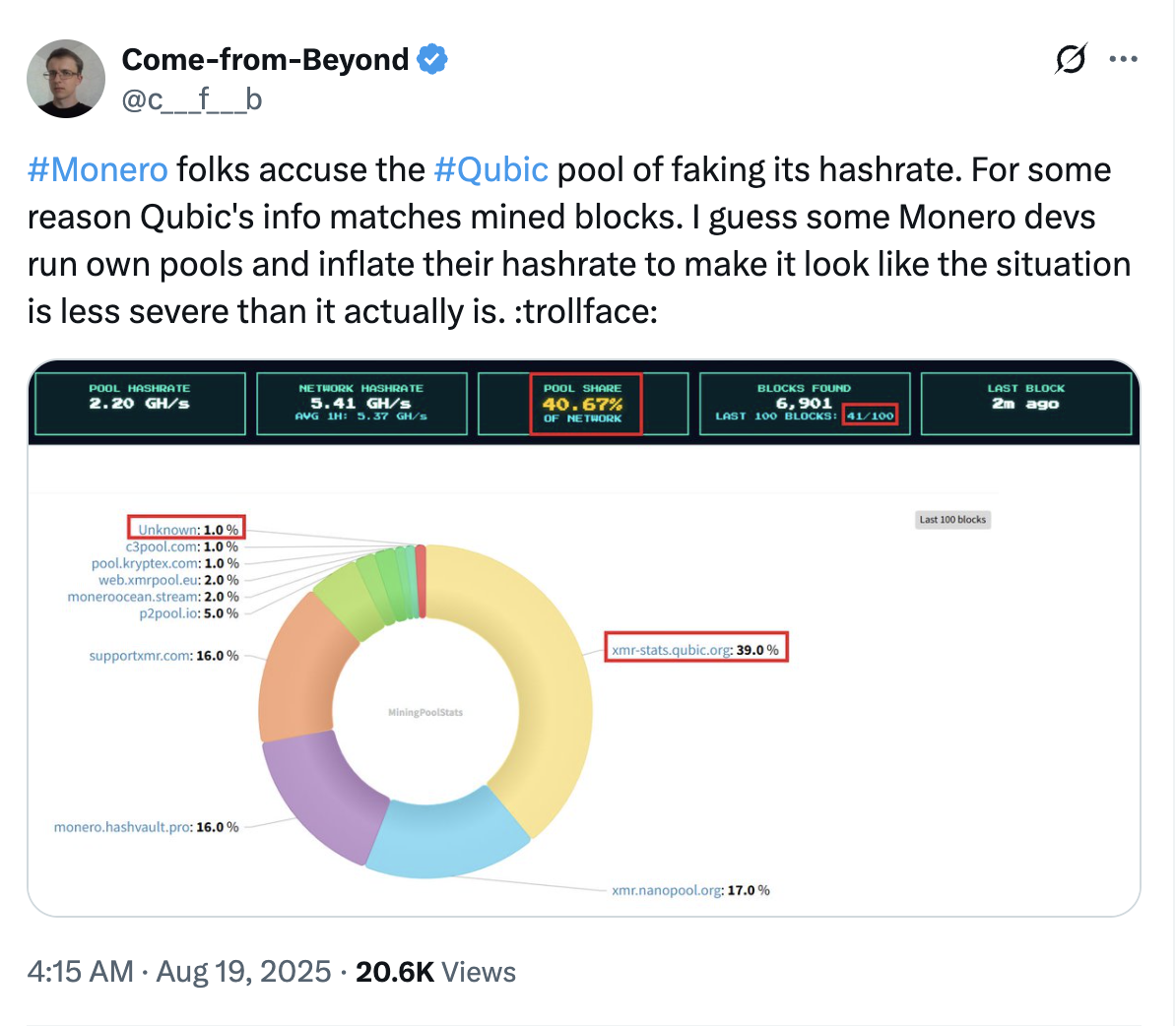
The Qubic mining pool currently controls 2.18 gigahashes per second (GH/s), making it the miner with the most hashing power on the Monero network, according to MiningPoolStats.
Supportxmr is the second-largest mining pool by hashing power, commanding 1.18 GH/s of computing power at the time of this writing.
Monero’s community remains divided on the attack, with a portion of Monero users claiming that Qubic never achieved majority control over the network’s hashing power and only managed a limited block reorganization, not a majority takeover of the network.
Despite the denials, Kraken, a major crypto exchange, announced it was temporarily suspending Monero deposits, and, in a subsequent update, Kraken re-enabled deposits, but stipulated that 720 confirmations are required before crediting accounts with XMR.
“Given the current uncertainty around the security of the Monero network due to significant consolidation of hash rate under a single entity, Kraken may halt deposits at any time and delay crediting at its discretion,” the exchange wrote in an update on Monday.
On Sunday, the Qubic community voted to make Dogecoin (DOGE) its next mining target, earning over 300 votes from community members — more than all the other options combined.
Following the vote, Sergey Ivancheglo, the founder of the Qubic network, clarified that DOGE mining “requires months of development,” and the mining pool is currently focused on mining XMR.
Magazine: Inside a 30,000 phone bot farm stealing crypto airdrops from real users
