


Nasdaq-listed healthcare service provider and Bitcoin treasury company KindlyMD has acquired $679 million worth of Bitcoin for its corporate reserve.
KindlyMD acquired 5,744 Bitcoin (BTC) for about $679 million at a weighted average price of $118,204 per Bitcoin, the company announced Tuesday.
The purchase was made using private investment in public equity (PIPE) proceeds and reflects KindlyMD’s “disciplined Bitcoin treasury strategy,” the company said.
The $679 million buy marks the company’s first Bitcoin investment since completing its merger with David Bailey’s Bitcoin firm, Nakamoto Holdings, on Friday.
KindlyMD’s purchase is more than 13 times larger than the latest acquisition by Michael Saylor’s Strategy, which said Monday it had bought $51.4 million worth of Bitcoin at an average price of $119,666. Strategy remains the largest public Bitcoin holder.
Still, the 5,769 Bitcoin represents a small fraction of KindlyMD’s plan to acquire 1 million BTC.
Is Bitcoin Headed for a 2025 Peak? Or is the 4-Year Cycle Dead? https://t.co/DckFjvkJIx
— Cointelegraph (@Cointelegraph) August 18, 2025
Related: Record $37T US debt and M2 money growth set stage for $132K Bitcoin
Bitcoin is the “ultimate reserve asset” for corporations and institutions: David Bailey
The new company’s long-term mission to acquire 1 million Bitcoin reflects a “belief that Bitcoin will anchor the next era of global finance,” said David Bailey, CEO and chairman of KindlyMD.
“This acquisition reinforces our conviction in Bitcoin as the ultimate reserve asset for corporations and institutions alike.”
Bailey also served as a key crypto adviser during US President Donald Trump’s campaign and was largely credited with the president’s favorable Bitcoin shift.
Earlier this month, he said he wants to raise $200 million for a political action committee (PAC) to advance Bitcoin’s interests in the US.
Related: Bitcoin’s corporate boom raises ‘Fort Knox’ nationalization concerns
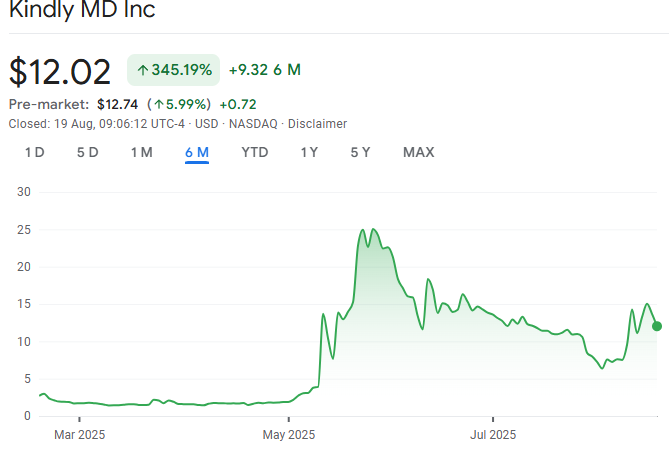
KindlyMD’s stock, however, has fallen more than 12% since the merger was announced on May 12, according to Google Finance data.
The company’s move comes as other firms accelerate Bitcoin treasury strategies. Japanese investment firm Metaplanet recently said it plans to raise $3.7 billion to fuel its own corporate strategy of buying 210,000 BTC by 2027.
Developments such as corporate Bitcoin adoption and potential inclusion of digital assets in US 401(k) retirement plans could help push Bitcoin to $200,000 by the end of 2025, according to André Dragosch, head of European research at crypto asset manager Bitwise.
“This “bullish” development may be even “bigger than the US Bitcoin ETF approval itself,” signaling another $122 billion worth of new capital, assuming a modest 1% portfolio allocation, Dragosch told Cointelegraph during the Chain Reaction X spaces show on Monday.
Magazine: Bitcoin OG Willy Woo has sold most of his Bitcoin — Here’s why
